X2
X3...
XN=X0).
Then set O = {X1,X2,X3...XN}can
be called set of all objects.
X2
X3...
XN=X0).
Then set O = {X1,X2,X3...XN}can
be called set of all objects.Theory
Problem Algebra
During the process of thinking, we are
splitting the complex objective reality - the surrounding world - into
separate objects. Object is a defined part of
the objective reality and will be further on marked by capital letters X,
Y, Z. Objects can be very small, like some elementary
particles, quantum of light, atoms, molecules, cells or very large like
man, house, city, country, planet, etc. An object Z
can be considered as objects X and Y
instead when referring to the same part of the objective reality in
both cases, or the other way around Z instead of X
and Y - these operations are called decomposition
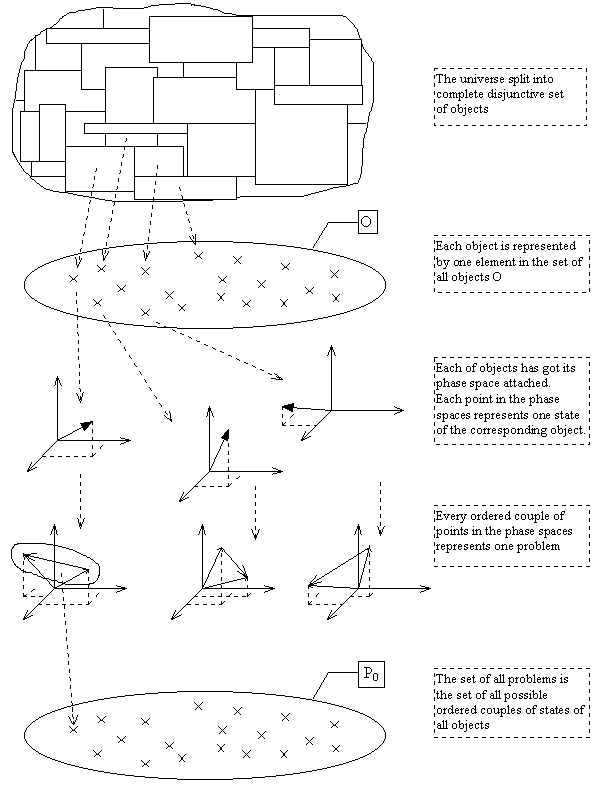
/ composition of objects. We can imagine whole universe X0
split into objects X1,X2,X3...XN so
that composition of these objects is the whole universe (X1
X2
X3...
XN=X0).
Then set O = {X1,X2,X3...XN}can
be called set of all objects.
State of object
is the arrangement of the internal parts of the object as well as its
position, velocity and other quantities at one moment. If the state of
an object X can be described by quantities (physical,
chemical, biological or other) Q1,Q2,Q3...Qn
the values x1, x2, ... xn of these
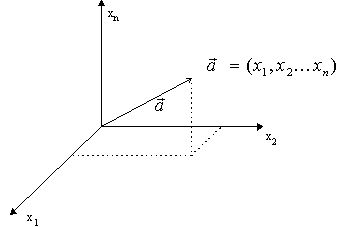
quantities can be considered as coordinates in n-dimensional space
called phase space. Each point in the phase
space represents one state of the object X. Values x1,
x2, ... xn are components of the state vector  . Object X
in state is marked by X(). With the approximation
defined by the quantities Q1,Q2,Q3...Qn
the phase space represents all possible states of the object X.
. Object X
in state is marked by X(). With the approximation
defined by the quantities Q1,Q2,Q3...Qn
the phase space represents all possible states of the object X.
Whenever we are doing any work, having a trouble with
something or would like to achieve a goal, the purpose or substance of
that can be exactly described by defining part of the objective reality
(so called problem object) and its two states (initial -
unfavorable and final - desirable) of that part of the objective
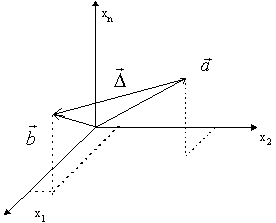
reality. Therefore problem is generally
defined as ordered couple of states of an object,
in symbols X[, ]
]  [X(), X()]. Vector is
called the initial state vector, the
final state vector,
[X(), X()]. Vector is
called the initial state vector, the
final state vector,  -(delta) the change state vector.
In the phase space of object X the problem is
represented by two points with defined order (sequence).
-(delta) the change state vector.
In the phase space of object X the problem is
represented by two points with defined order (sequence).
Problems can be composed and
decomposed serially ( X[,]
+ X[, ] = X[,]
) or in parallel ( X[,] + Y[,
] = X[,]
) or in parallel ( X[,] + Y[, ] = Z[
 ,
, ] ; XY=Z ). As inverse
problem to problem X[,] is called
the problem X[,]. Zero problem
is such problem X[,] that = . Composition of problem and its inverse
problem is the zero problem (X[,] + X[,] = X[,]).
If the initial state vector represents the current (present) state of the object X, the
problem X[,] is called
actual, otherwise it is called virtual.
Solution of problem X[,]
is generally an external force affection that induces the object X to
change its state from
to . Composition of solutions of
individual subproblems is one possible solution of the composed problem.
] ; XY=Z ). As inverse
problem to problem X[,] is called
the problem X[,]. Zero problem
is such problem X[,] that = . Composition of problem and its inverse
problem is the zero problem (X[,] + X[,] = X[,]).
If the initial state vector represents the current (present) state of the object X, the
problem X[,] is called
actual, otherwise it is called virtual.
Solution of problem X[,]
is generally an external force affection that induces the object X to
change its state from
to . Composition of solutions of
individual subproblems is one possible solution of the composed problem.
Biology of Problems
Abstract problems can get reflected
(incarnated) in human brain: imagination of an object X
in a state which
we don't like or in a state which
we would like to achieve, or both, are implemented by a nerve pulse in
our central nerve system. More specifically a couple neuron loops with
a nerve pulse (which is running through periodically) can be considered
as the problem X[,] reflection.
Because any
attempt to solve a well-defined problem X[,]
within a given time period T does have an unambiguous result (yes/no)
the solubility of problem is measurable, man
and time dependent quantity. Symbols S(t) and N(t) are used for the
sets of all soluble resp. insoluble problems.
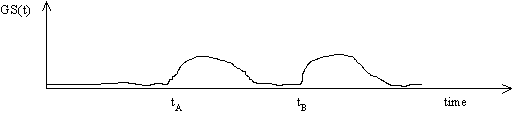
Problems influence dissatisfaction or contentment of people. Dissatisfaction can be represented by a biochemical quantity GS (global state) definable based on various chemical, electrical and other quantities measurable in the central nerve system. GS can have values 0 (contentment) to GSmax (extreme discontentment), and can be seen as function of time GS = GS(t). On the example drawing problems appeared at moments tA and tB and caused some increase of discontentment:
Instead of time-dependent, the quantity GS
(describing discontentment) can be seen as function of state of object
GS = GS(X()) defined for
all states of all objects, because different states of different
objects bring us different discontentment. In human brain, the
connection object state X()
<=> dissatisfaction GS(X()) is implemented by neuron connections between the brain
area implementing the object X in the stat and the emotion related structures..
Importance
 GS of problem
X[,] is defined as GS(X[,]) = GS(X()) - GS(X())
and is man dependent and measurable quantity. It says something like
how much our contentment will increase if we solve the problem X[,].
GS of problem
X[,] is defined as GS(X[,]) = GS(X()) - GS(X())
and is man dependent and measurable quantity. It says something like
how much our contentment will increase if we solve the problem X[,].
The neuron connections implementing importance of problems were either inherited or mostly created during our lives by our own subjective thinking. In any case the minimum possible importance is zero, because any of these neuron synaptic connections has the biological capability of disconnection (relaxation). Therefore so called general principle of problem subjectivity is exactly valid:
GSmin(X[,],t) = 0;  X[,], t
"Importance of any problem is only subjective" - in
other words the objective importance (defined as minimal subjective
importance) of any problem at any time is zero. This means that we can
stay completely content at moment t even if we do not solve the problem
X[,].
General principle of problem subjectivity is of no practical benefit because considering all problems as objectively unimportant would increase our discontentment (it is mostly of better advantage simply to solve the problem instead). By minimizing contribution of random problem to the discontentment we come to so called contracted principle of problem subjectivity (briefly called "principle of problem subjectivity"):
X[,] N(t)
N(t)  GSmin(X[,],t)
= 0; t
GSmin(X[,],t)
= 0; t
i.e. problem that is not soluble at moment t is important only subjectively (seemingly) at that moment (or alternatively every problem is either soluble at moment t or objectively unimportant at that moment). Reason for exact validity of this assertion is the objectively existing (biological) possibility of complete disconnection of the neural path which implements the "problem importance". The principle is called "contracted" because we contract (reduce) the assertion of the general principle of problem subjectivity only to the set of all insoluble problems. There are no contradictions in the assertion of the principle of problem subjectivity, not even close to our death because the principle has differential character in the time scale, and global state of our brain (contentment) at the present moment is considered the basic value all the other things are bound to using neuron-based connections.
We can remember the principle of problem subjectivity as follows:
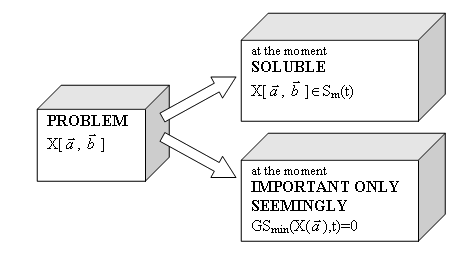
or as follows:
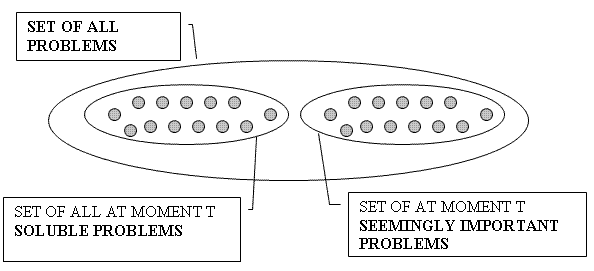
And finally logical construction of the set of all problems: